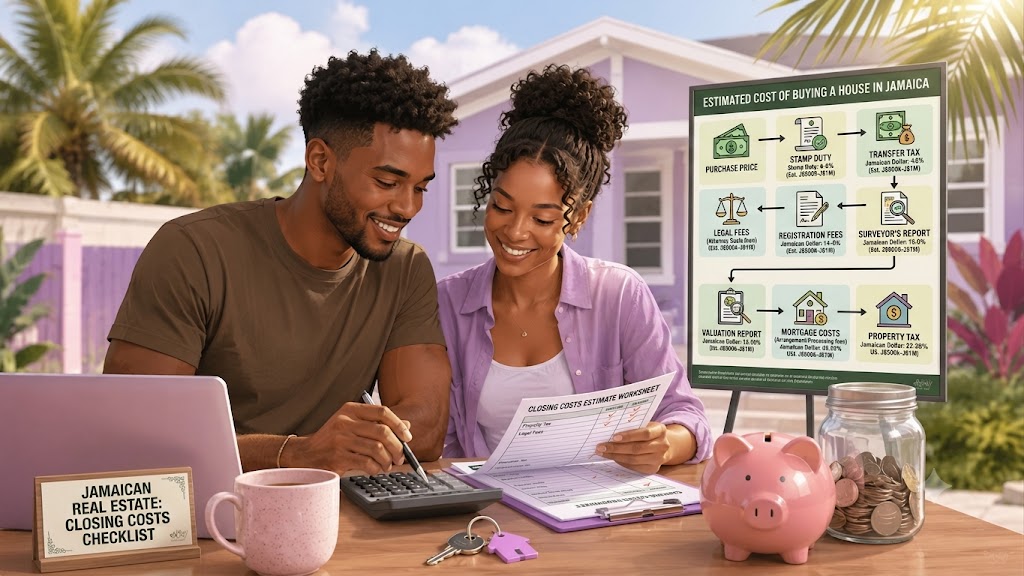
So, you’ve been browsing property listings, falling in love with a charming bungalow in St. Ann or a chic apartment in Kingston, and you’re ready to make your move. You’ve figured out the purchase price, but here is the truth every seasoned home buyer in Jamaica knows: the sticker price isn’t the whole story.
Whether you’re living on the island or searching from the diaspora in London, New York, or Toronto, budgeting for a home requires looking past the principal asking price. To avoid any surprise roadblocks on closing day, here is a clear, realistic breakdown of what it actually costs to buy a house in Jamaica.
1. The Upfront Commitment: Deposit (5% – 10%)
Once your offer is accepted, the vendor will ask for a deposit upon signing the Agreement for Sale.
- Typical Amount: Usually 10% of the purchase price (though some vendors accept 5%).
- What to know: This money goes into an escrow account held by the vendor’s attorney until the sale closes.
2. Closing Costs & Legal Fees (3% – 5%)
Many first-time buyers budget for their down payment but get caught off guard by closing costs. In Jamaica, buyers should generally set aside an extra 3% to 5% of the purchase price in cash to cover administrative and professional fees.
Here is where that money actually goes:
Statutory & Government Fees
- Stamp Duty: A flat fee of JMD $5,000, split equally between buyer and vendor (so your portion is $2,500).
- Title Registration Fee: Payable to the National Land Agency (NLA) at 0.5% of the property value, also split 50/50 with the seller (your share is 0.25%).
- Transfer Tax: Good news! In Jamaica, the 2% Transfer Tax is paid by the seller, not the buyer.
Legal Representation
- Attorney Fees: In Jamaica, each party hires their own legal counsel. A buyer’s conveyancing attorney typically charges 2% to 3% of the sale price plus 16.5% GCT (General Consumption Tax) on their fee.
- Agreement Preparation: You will also split the cost of preparing the Agreement for Sale with the vendor.
3. Out-of-Pocket Professional & Inspection Fees
Before a bank or building society approves your mortgage (or before you sign off on a cash deal), you will need two key reports:
- Surveyor’s Report: Confirms boundaries and ensures there are no restrictive covenant breaches (e.g., building too close to the road). Cost: JMD $40,000 – $70,000+.
- Valuation Report: Required by mortgage lenders to verify the property’s current market value. Cost: ~0.25% to 0.5% of property value.
4. Mortgage-Related Expenses (If Financing)
If you’re financing through institutions like JN Bank, NCB, Victoria Mutual (VMBS), or the National Housing Trust (NHT), remember to account for loan-specific fees:
- Bank Processing Fees: Usually 1% – 2% of the total loan amount.
- Mortgage Registration & Stamp Duty: Government charges for noting the mortgage on the Certificate of Title.
- Home Insurance & Title Insurance: Lenders require home/hazard insurance upfront, and title insurance protects your ownership stake against defects on the land title.
Quick Rule of Thumb:
When setting your budget, save 10% for the deposit plus an additional 5% in liquid cash to comfortably cover all legal fees, government taxes, reports, and closing costs.
Buying a home in Jamaica is one of the most rewarding investments you can make—whether for family living, retirement, or rental income. Knowing the numbers ahead of time gives you leverage, keeps your stress low, and ensures your path to property ownership is smooth from day one.
Leave a Reply